
Math practice doesn’t always need to begin with a workbook.
United States, 5th Sep 2026 - Children encounter numbers, measurements, patterns, shapes, and problem-solving opportunities throughout an ordinary day. A trip to the grocery store, an afternoon in the kitchen, a family game, or even setting the dinner table can become an opportunity to strengthen mathematical thinking.
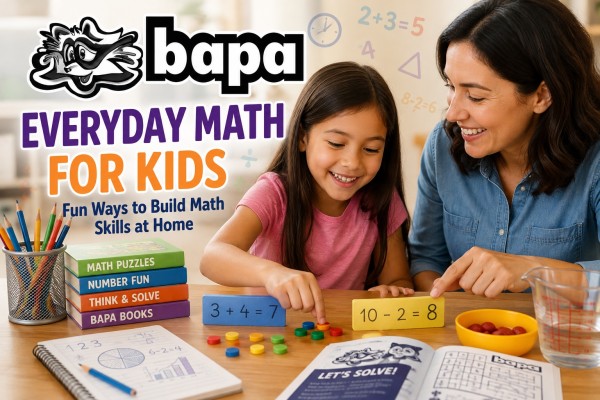
For parents and caregivers, the trick isn’t turning every activity into a formal lesson. It’s helping children notice the math that is already happening around them.
When numbers become connected to familiar experiences, math can feel more useful, understandable, and—yes—even fun.
Start in the Kitchen
Cooking and baking provide an almost endless supply of practical math.
Young children can count ingredients or spoonfuls. As they get older, they can measure ingredients, compare quantities, work with fractions, and keep track of cooking times.
Try involving your child with questions such as:
- How many eggs do we need?
- Which is larger: 1/2 cup or 1/4 cup?
- If the recipe makes 12 cookies, how many would each person get if four people shared them equally?
- If dinner needs to cook for 30 minutes, what time will it be ready?
These aren't hypothetical problems from a textbook. The answers actually matter to what the child is doing, which gives the math an immediate purpose.
Put Kids in Charge of Some Grocery Math
The grocery store is another terrific place to practice.
Ask younger children to count the items you need. If you need eight apples and already have five in the bag, ask how many more are needed.
Older children can compare prices or estimate how much several items will cost together.
You can also give them a small imaginary—or real—budget.
For example, challenge them to find a snack that costs less than $5 or choose several items without exceeding $10.
Activities like these combine arithmetic with decision-making and introduce the idea that math is an everyday life skill.
Teach Math Through Money
Coins and bills make numbers tangible.
Younger children can learn to recognize different coins and understand that coins of different sizes don't necessarily have greater values. They can sort coins, count them, and practice making specific amounts.
A pretend store is another easy activity.
Put simple prices on toys or household objects and take turns being the customer and cashier.
As children become more confident, introduce questions involving change:
“If something costs $6 and you pay with $10, how much should you get back?”
You're practicing subtraction while also developing an important financial skill.
Turn Travel Time Into Number Time
Even driving across town can provide a few minutes of informal learning.
For younger children, try counting games. Count traffic lights, trucks, certain colors of cars, or objects along the road.
Older children can work with distance and time:
“We're 15 miles away. If we've already traveled five miles, how far do we have left?”
Or:
“We need to arrive at 4:00 and it takes about 25 minutes to get there. When should we leave?”
License plates can also provide quick number games. Pick a plate and ask children to add or subtract the digits.
No pencils required.
Play Games That Involve Numbers and Strategy
Many children's games quietly teach mathematical thinking.
Board games can involve counting, recognizing numbers, calculating scores, comparing values, identifying patterns, and planning several moves ahead.
Building toys are equally useful. Blocks and construction sets introduce children to size, shape, symmetry, balance, and spatial reasoning.
Even sorting a collection of toys can become mathematical.
Children can group objects by color, shape, or size and then compare the groups:
Which has the most?
Which has the fewest?
How many are there altogether?
How many would each person receive if we divided them evenly?
It feels like play because it is play. The mathematical thinking simply happens alongside it.
Discover Geometry in the Real World
Shapes aren't confined to geometry worksheets.
They're everywhere.
Take a walk and see how many circles, rectangles, triangles, and squares your child can identify. Road signs, windows, buildings, playground equipment, floor tiles, and everyday objects provide plenty of examples.
Patterns can be explored in much the same way.
Look for repeating colors or shapes in clothing, fences, buildings, decorations, and nature. Then encourage children to create patterns of their own with crayons, blocks, beads, or other objects.
This helps children develop visual and spatial reasoning while showing them that mathematical ideas exist throughout their environment.
Bring Math Into Their Favorite Sports
For a sports-loving child, statistics and scores can make math immediately more interesting.
Instead of presenting an abstract subtraction problem, ask:
“Our team has 17 points and the other team has 21. How many points do we need to tie?”
Children can add scores, calculate differences, compare player statistics, track wins and losses, and eventually explore averages and percentages.
The underlying math may be exactly the same as a classroom exercise, but the context changes how the child experiences the problem.
Interest is a powerful teaching tool.
Find Math in Household Projects
Children can also practice math while helping around the house.
Setting a table involves counting. Organizing objects involves sorting and classification. Gardening involves measurement, spacing, counting, and tracking growth.
Home improvement projects can introduce older children to length, width, area, and estimation.
Need to determine whether a new rug will fit in a room?
Grab a tape measure and let your child help.
Instead of simply telling children that measurement is useful, you're giving them an opportunity to see exactly why it matters.
Encourage Children to Explain Their Thinking
Learning math isn't only about reaching the correct answer.
Understanding how to approach a problem is equally important.
When your child is working something out, give them a little time before stepping in with the solution.
Ask questions such as:
“How did you figure that out?”
“What could you try next?”
“Could we solve it another way?”
“Does your answer make sense?”
Children won't always get it right on the first attempt—and that's okay. Examining a mistake and trying a different strategy is part of developing stronger problem-solving skills.
The objective is to help children become comfortable thinking through problems rather than becoming afraid of getting an answer wrong.
Combine Everyday Learning with Fun Math Activities
Real-life experiences help children understand why math is useful. Games, puzzles, and activity books can complement those experiences by giving kids additional opportunities to practice specific skills.
The best practice doesn't necessarily feel like repetitive schoolwork.
Number puzzles, mathematical challenges, cryptograms, and other engaging activities can encourage children to experiment with numbers while strengthening arithmetic and problem-solving skills.
That philosophy is also behind the math activities created by Bapa Books, where learning is combined with puzzles, creativity, and play to make practicing important skills more enjoyable for young learners.
Raising Kids Who Aren't Afraid of Numbers
Parents don't have to be math teachers to encourage mathematical thinking.
You don't need elaborate lesson plans, either.
Simply look for opportunities already built into family life.
Measure something. Count something. Compare two prices. Estimate how long a trip will take. Divide a snack equally. Play a game. Find a pattern. Ask your child how they arrived at an answer.
Small experiences add up.
Over time, children begin to recognize something important: math isn't just a school subject.
It's a tool they already use to understand the world.
And when children begin viewing problems as things they can figure out rather than things they should fear, they're developing a skill that reaches far beyond mathematics.
About Bapa Books: Bapa Books creates educational activity and puzzle books designed to make learning engaging, approachable, and fun for children. Explore Bapa Books' collection of math activities and educational books for young learners.
For more information, check out Bapa Books and Bapa’s Word Puzzle Books, Coloring Books for Kids, and Number Sense Books. Follow us on Facebook and X.
This content is for general reading purposes only and should not be considered as medical or professional advice
Media Contact
Organization: Bapa Books
Contact Person: Office Manager
Website: https://bapabooks.com
Email: Send Email
Country:United States
Release id:48863
The post Make Math Part of the Day: Simple Ways Children Can Learn Through Real Life appeared first on King Newswire. This content is provided by a third-party source.. King Newswire is a press release distribution agency. We do not accept any responsibility or liability for the accuracy, content, images, videos, licences, completeness, legality, or reliability of the information contained in this article. If you have any complaints or copyright concerns related to this article, please contact the company listed in the ‘Media Contact’ section above.